|
THE
ASYMMETRIC DESIGN
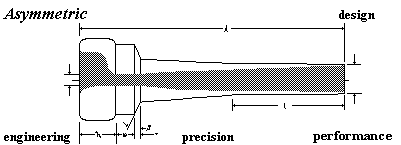
An
analytical/experimental technique called multiple nonlinear
regression was used with an orthogonal composite fractional
factorial experiment design to model the explicit operation
of upper and lower half-cup curvatures and cup depth along
with their interaction effects, in order to determine, generally,
the optimum cup geometry for extended high range performance.
This macro analysis resulted in the predicted asymmetry that
is the identifying feature of these mouthpieces. Then to refine
the specific cup design, a similar analysis which treated
the three characteristic curves (mouthpiece entrance, flow-converging
concave curve, and convex throat entrance) as independent
variables, for both top and bottom inside cup surfaces, enabled
explicit compound curvatures to be generated for those ideal
cup shapes that maximized high range. Then, prototypes were
made for balancing geometry (cup, backbore and throat size)
and tailoring sound, always keeping in mind the application
of each model. Additional consideration had to be given to
the low (below low C) register, which led to further modification
and more prototypes. This is the first time an analysis of
this kind has ever been applied to the trumpet mouthpiece.
In fact, I believe that these mouthpieces have undergone
more analytical scrutiny and are of a more sophisticated design
than any other. And the results show it!
|